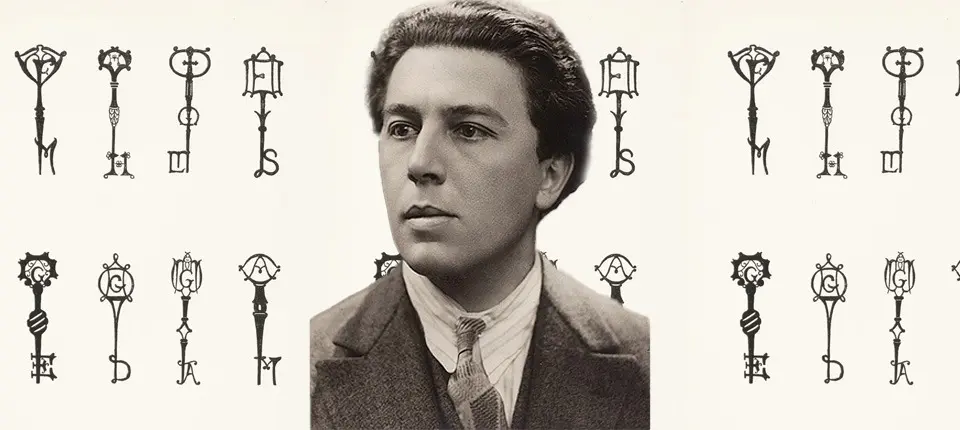
Breton’s leadership of the Surrealist group was characterized by both brilliant collaboration and notorious excommunications. He was a man of intense convictions, often purging members from the movement if their work or political affiliations drifted too far from his vision. Despite this perceived authoritarianism, he cultivated a circle of geniuses that included Louis Aragon, Paul Éluard, Salvador Dalí, René Magritte, and Max Ernst. His ability to synthesize poetry, visual art, and political activism into a singular, cohesive movement made Surrealism the most dominant and enduring avant-garde force of the 20th century.
His literary output was as varied as it was profound. In 1928, he published Nadja, a genre-defying work that stands as a cornerstone of Surrealist literature. Part memoir, part novel, and part photographic essay, Nadja chronicles Breton’s brief and haunting relationship with a young woman in Paris. The book is famous for its opening question—"Who am I?"—and its exploration of the "convulsive beauty" that Breton believed was the only true form of beauty. To Breton, beauty was not something to be admired passively; it was something that should shock the system, arriving through chance encounters and the juxtaposition of seemingly unrelated objects or ideas.
Breton’s influence was not confined to the page or the canvas; it was deeply rooted in the political upheavals of his time. Like many of his contemporaries, he saw a natural alliance between the liberation of the mind and the social revolution. For a time, he was a member of the French Communist Party, though his relationship with the party was fraught with tension. Breton famously insisted that "the transformation of the world" (as called for by Marx) and "the changing of life" (as called for by Rimbaud) were two sides of the same coin.
This political commitment led him to Mexico in 1938, where he met with the exiled Leon Trotsky. Together, they authored the Manifesto for an Independent Revolutionary Art, which declared that "the independence of art—for the revolution; the revolution—for the complete liberation of art." This document reflected Breton’s refusal to allow art to be used as a mere tool for state propaganda, even in the service of a cause he believed in. He remained a fierce defender of the artist’s right to absolute freedom of expression, a stance that often put him at odds with the socialist realism favored by the Soviet Union.
When World War II broke out and the Nazi occupation of France began, Breton was forced into exile. He spent the war years in the United States, primarily in New York City, where he continued to promote Surrealist ideals. His presence in America had a profound impact on the development of the New York School and the emergence of Abstract Expressionism. By the time he returned to France in 1946, the world had changed. The horrors of the Holocaust and the dawn of the atomic age had created a new intellectual climate, one dominated by the Existentialism of Jean-Paul Sartre.