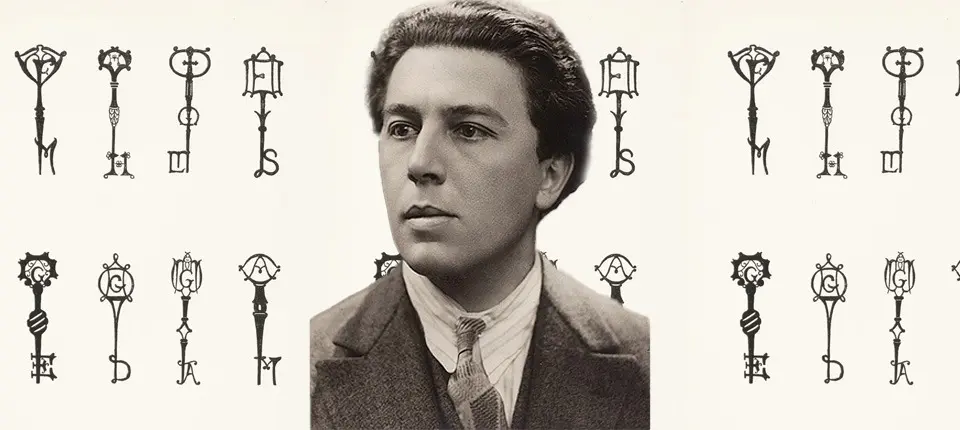
On this day in 1966, the literary and artistic world lost one of its most polarizing and influential figures. André Breton, the French writer, poet, and principal founder of the Surrealist movement, passed away in Paris at the age of 70. His death marked the end of an era for the avant-garde, yet it also solidified his status as the "Pope of Surrealism," a title he earned through decades of rigid intellectual leadership and an unwavering commitment to the liberation of the human mind.
Breton’s passing on September 28, 1966, followed a period of declining health, but his intellectual vigor had remained largely undiminished until the end. As he was laid to rest in the Batignolles Cemetery in Paris, a city he had spent his life transforming into a landscape of dreams and subconscious discovery, the global literary community paused to reflect on a legacy that spanned two world wars and fundamentally altered the trajectory of modern art and literature.
Born in 1896 in Tinchebray, Orne, Breton’s early life was marked by the clinical and the chaotic. During World War I, he served in neurological wards, where he encountered the burgeoning field of Freudian psychoanalysis. Working with soldiers suffering from shell shock, Breton became fascinated by the power of the unconscious mind and the "automatic" expressions of the traumatized psyche. These experiences provided the raw material for what would become Surrealism—a movement dedicated to resolving the previously contradictory conditions of dream and reality into an absolute reality, or a "surreality."
Breton’s journey into the heart of the literary internet of his time began with his involvement in Dadaism. Alongside figures like Tristan Tzara, Breton initially embraced the nihilistic, anti-art sentiment of the Dada movement in the aftermath of the Great War. However, Breton soon found Dada’s commitment to pure destruction limiting. He sought a more constructive path, one that used the irrational not just to mock the bourgeoisie, but to unlock a deeper human truth. This philosophical pivot led to the publication of the first Manifesto of Surrealism in 1924, a document that remains one of the most significant manifestos in the history of the arts.
In the manifesto, Breton defined Surrealism as "psychic automatism in its pure state, by which one proposes to express—verbally, by means of the written word, or in any other manner—the actual functioning of thought." He argued that the dictates of reason, aesthetic concerns, and moral preoccupations were merely shackles that prevented humanity from accessing the true richness of the imagination. By advocating for automatic writing and the recording of dreams, Breton invited writers and artists to bypass the conscious mind and tap into the "merveilleux," or the marvelous, which he believed resided in the everyday.
Breton’s leadership of the Surrealist group was characterized by both brilliant collaboration and notorious excommunications. He was a man of intense convictions, often purging members from the movement if their work or political affiliations drifted too far from his vision. Despite this perceived authoritarianism, he cultivated a circle of geniuses that included Louis Aragon, Paul Éluard, Salvador Dalí, René Magritte, and Max Ernst. His ability to synthesize poetry, visual art, and political activism into a singular, cohesive movement made Surrealism the most dominant and enduring avant-garde force of the 20th century.
His literary output was as varied as it was profound. In 1928, he published Nadja, a genre-defying work that stands as a cornerstone of Surrealist literature. Part memoir, part novel, and part photographic essay, Nadja chronicles Breton’s brief and haunting relationship with a young woman in Paris. The book is famous for its opening question—"Who am I?"—and its exploration of the "convulsive beauty" that Breton believed was the only true form of beauty. To Breton, beauty was not something to be admired passively; it was something that should shock the system, arriving through chance encounters and the juxtaposition of seemingly unrelated objects or ideas.
Breton’s influence was not confined to the page or the canvas; it was deeply rooted in the political upheavals of his time. Like many of his contemporaries, he saw a natural alliance between the liberation of the mind and the social revolution. For a time, he was a member of the French Communist Party, though his relationship with the party was fraught with tension. Breton famously insisted that "the transformation of the world" (as called for by Marx) and "the changing of life" (as called for by Rimbaud) were two sides of the same coin.
This political commitment led him to Mexico in 1938, where he met with the exiled Leon Trotsky. Together, they authored the Manifesto for an Independent Revolutionary Art, which declared that "the independence of art—for the revolution; the revolution—for the complete liberation of art." This document reflected Breton’s refusal to allow art to be used as a mere tool for state propaganda, even in the service of a cause he believed in. He remained a fierce defender of the artist’s right to absolute freedom of expression, a stance that often put him at odds with the socialist realism favored by the Soviet Union.
When World War II broke out and the Nazi occupation of France began, Breton was forced into exile. He spent the war years in the United States, primarily in New York City, where he continued to promote Surrealist ideals. His presence in America had a profound impact on the development of the New York School and the emergence of Abstract Expressionism. By the time he returned to France in 1946, the world had changed. The horrors of the Holocaust and the dawn of the atomic age had created a new intellectual climate, one dominated by the Existentialism of Jean-Paul Sartre.
While Sartre’s focus on individual responsibility and "engagement" gained popularity, Breton remained steadfast in his belief in the power of the mythic and the irrational. He continued to organize international Surrealist exhibitions and publish new works, such as Arcane 17, written during a trip to the Gaspé Peninsula in Quebec. Though some critics in the 1950s and 60s viewed Surrealism as a relic of the past, Breton’s influence continued to permeate the culture, surfacing in the works of the Beat Generation in America and the Situationists in Europe.
In his final years, Breton lived in an apartment on the Rue Fontaine, surrounded by his massive collection of indigenous art, rare books, and "found objects." This collection was, in many ways, a physical manifestation of his mind—a curated chaos where the primitive and the modern, the natural and the manufactured, coexisted in a state of perpetual tension. Even as his physical world narrowed, his intellectual horizon remained vast. He continued to correspond with young poets and artists, proving that Surrealism was not a static dogma but a living, breathing method of engagement with the world.
The news of his death in 1966 sent shockwaves through the international arts community. Obituaries at the time described him as a man who had "given the world a new pair of eyes." In the decades since, his reputation has only grown. The digital age, with its rapid-fire juxtaposition of images and ideas, its algorithmic chance encounters, and its blurring of the boundaries between the real and the virtual, can often feel like a Surrealist dream brought to life. The "literary internet" of today owes a debt to Breton’s early experiments with collective creativity and the democratization of the imagination.
As we look back on the legacy of André Breton sixty years after his death, we see more than just a poet or a theorist. We see a man who understood that the greatest revolution is one that takes place within the human spirit. He taught us that the world is not merely what we see, but what we are capable of imagining. By championing the irrational, the accidental, and the marvelous, Breton ensured that the "best of the literary internet"—and the best of human creativity—would always remain a place of endless, convulsive possibility.
His funeral in 1966 was a quiet affair, but the silence was deceptive. The seeds he planted had already scattered across the globe, taking root in every corner of the human experience. Today, every time an artist trusts a gut instinct over a logical plan, every time a writer follows a strange thread of thought into the unknown, and every time a reader finds truth in the logic of a dream, the spirit of André Breton lives on. He remains the architect of our subconscious, reminding us that, even in the face of death, the imagination remains the only truly sovereign territory.