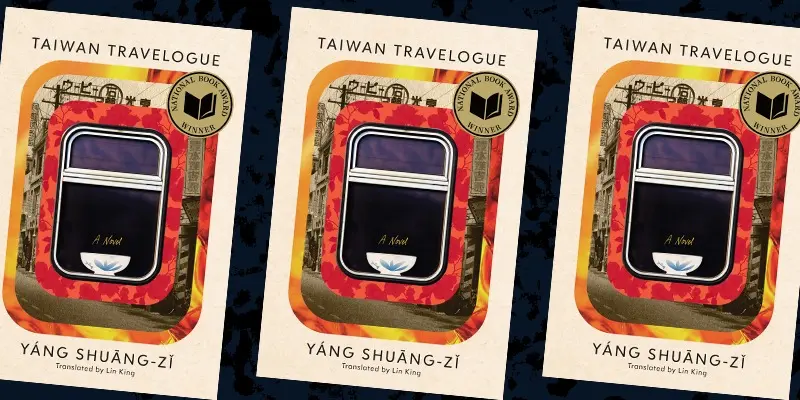
Lin King, the acclaimed translator and writer responsible for the English-language version of Yang Shuang-zi’s Taiwan Travelogue, has publicly announced a legal challenge against an unnamed European publisher, alleging a significant violation of her intellectual property rights. In a detailed statement released via Instagram on Tuesday, King laid out a compelling case regarding the unauthorized use of her translation as the basis for a third-language edition, a practice known in the industry as "relay translation." The dispute has quickly become a focal point for discussions regarding the creative agency of translators and the legal protections afforded to those who bridge the gaps between the world’s many languages.
The controversy centers on Taiwan Travelogue, a novel originally written in Mandarin by Yang Shuang-zi under the title Tâiwân Màn Yóu Lù. King’s English translation, which has garnered international acclaim and secured a prestigious Booker Prize, is at the heart of the legal proceedings. According to King, she recently discovered that a European publishing house was moving forward with plans to release a version of the book translated not from the original Mandarin text, but directly from her English rendition. Despite King issuing "repeated warnings" to the publisher that such a move was legally untenable without her express consent, the publisher apparently intended to proceed, prompting King to seek judicial intervention.
The crux of King’s argument rests on the legal and artistic ownership of a translated text. While the original author, Yang Shuang-zi, holds the copyright to the Mandarin work, King asserts that she is the "sole copyright owner" of the English-language version. In the world of international publishing, a translation is generally recognized as a derivative work that carries its own distinct copyright, belonging to the translator unless contractually surrendered. Therefore, when a third party uses that specific English text as a "bridge" to create a version in another language—such as French, German, or Spanish—they are effectively translating King’s creative work, not just Yang’s. Without a license or authorization from King, this process constitutes a breach of copyright.
King’s statement goes far beyond the technicalities of intellectual property law, offering a profound and moving defense of translation as a high art form. She challenges the persistent and often reductive view of translation as a purely mechanical or clerical task. Instead, King argues that translation is an act of deep adaptation, comparable to other forms of creative reinterpretation. To illustrate her point, she draws a parallel to the world of cinema and music, noting that a translator’s work is not unlike a filmmaker reinterpreting a literary classic for the silver screen. She famously cites Whitney Houston’s iconic cover of Dolly Parton’s "I Will Always Love You," pointing out that while audiences may debate which version is "better," it is indisputable that the two performances are fundamentally different creative entities.
By framing translation as a performance, King provides a vivid look into the labor involved in her craft. She suggests that if a writer is a scriptwriter, the translator must be the actor who brings the lines to life; if the writer is a composer, the translator is the musician interpreting the score; and if the writer is a choreographer, the translator is the dancer embodying the movement. Each of these roles requires a series of artistic choices—inflection, rhythm, tone, and emphasis—that directly impact how the audience receives the original work. In King’s view, the translator is not a transparent window through which a story passes, but an active participant whose "every one of the performer’s artistic choices" shapes the final product.
This perspective challenges the "false binary" that King says she often encounters when asked whether she identifies more as a writer or a translator. She asserts that while not all writers possess the skill set to be translators, every translator is, by necessity, a writer. The English version of Taiwan Travelogue is composed of words chosen by King from the "chaotic expanses of the English lexicon." She points out the inherent irony of the craft: the original author, Yang Shuang-zi, cannot read the English version of her own book, just as King will likely be unable to read the various other translations of the novel scheduled for publication next year. In these instances, it is the translators who are "writing" those specific books for their respective linguistic audiences.
The legal action has received significant backing from the literary community, most notably from King’s own publisher. Yuka Igarashi, the Executive Editor at Graywolf Press, which brought the English version of Taiwan Travelogue to the American market, has stood firmly behind King. Igarashi noted that King’s "inspired translation" of Yang’s novel is a testament to the fact that translators are writers in their own right. She emphasized that as artists, mediators, and advocates, translators play an indispensable role in the global dissemination of literature. Graywolf’s support highlights a growing industry-wide movement to acknowledge the often-overlooked labor of translators and to ensure that their legal rights are respected by international partners.
King’s decision to pursue legal action is also a critique of the "unfair business practices" that she believes have become normalized within the publishing industry. She suggests that relay translations are often used as a cost-cutting measure or a shortcut, allowing publishers to bypass the need for a translator who is fluent in the original source language. By ignoring the copyright of the first translator, these publishers treat the English text as a public domain "template" rather than a protected work of art. King is seeking to disrupt this "status quo," arguing that the longevity of a practice does not justify its illegality. "Since when has ‘it’s always been done this way’ been a sufficient reason for continuing to infringe on people’s rights?" she asks in her statement.
For King, the motivation behind the lawsuit is not financial gain. She notes that the economics of literary translation are notoriously difficult, describing the profession as a "horrendous business plan." Her own journey with Taiwan Travelogue began with her volunteering her time and expertise without compensation, translating portions of the book and pitching it directly to U.S. publishers because of her deep belief in the quality and importance of Yang Shuang-zi’s storytelling. Her legal battle is, therefore, a matter of principle and a defense of the integrity of the profession. She is fighting to set a legal precedent that would force publishers to recognize the autonomy and ownership of translators worldwide.
The practice of relay translation is not inherently illegal if the proper permissions are obtained and the appropriate royalties are paid. However, it remains a controversial method because it creates a "double-filtered" version of the story. When a book is translated from Mandarin to English, and then from English to another language, the nuances, cultural specificities, and linguistic play of the original Mandarin are often diluted or lost entirely, replaced by the specific choices made by the English translator. By using King’s text without permission, the European publisher is not only infringing on her copyright but also potentially misrepresenting the original author’s work by basing a new edition on a "performance" they do not have the rights to replicate.
King’s statement concludes with a poignant and direct appeal to the global publishing industry. She "beseeches" publishers of translated fiction to shift their internal cultures toward a model of respect and transparency. Her message is simple: "Ask for permission, not forgiveness." She calls on those who claim to love and value international literature to extend that respect to the very people who make that literature accessible to them. If a publisher values a story enough to bring it to a new market, King argues, they must also value the rights of the translator who painstakingly rewrote that story in a new tongue.
As the legal proceedings against the European publisher move forward, the case is likely to be watched closely by literary agents, copyright lawyers, and translators across the globe. It represents a potential turning point in how the industry handles the complex web of rights involved in international book deals. For Lin King, the goal remains clear: to ensure that the "indisputable" difference between an original work and its translation is recognized not just as an artistic fact, but as a legal reality that demands protection. Her full statement, which continues to circulate and gain traction among literary circles, remains available on her Instagram profile, serving as both a legal notice and a manifesto for the dignity of the translator’s craft.